If you rely on a chiropractor to get out of pain, then you already know the relief never lasts, and you're far from alone. A 2018 Gallup survey commissioned by Palmer College of Chiropractic found that 16% (40 million) of American adults had seen a chiropractor in the previous year, up from 14% just three years earlier,1,2 and a 2024 NIH analysis of 2022 national survey data found that chiropractic care was the most widely used complementary approach for managing pain.3
What’s more telling is how long many of them keep going. In a RAND study of more than 1,500 patients receiving ongoing chiropractic care for chronic low back and neck pain, people averaged 2.3 visits a month, had been in pain for an average of 14 years, and had been seeing a chiropractor for an average of 11 of those years, and on average they believed their pain would roughly double if they stopped going.4,5
We wouldn’t call eleven years of appointments for the same pain a fix, but more of a subscription, and it’s the case because adjustments don't address the root cause of your pain.
The myth of the bone out of place
Chiropractic began with a single adjustment. In September 1895, D.D. Palmer, a magnetic healer in Davenport, Iowa, adjusted the spine of Harvey Lillard, a janitor in his building who had been deaf for 17 years, and Lillard later wrote that he could hear well again after two treatments.6 Palmer built a profession around the idea that vertebrae knocked out of place were behind people's problems, and that pushing the bone back into position would let the body heal itself.

More than a century later, that idea still shapes how most people think about getting adjusted, even though the research hasn't backed it up. A 2024 systematic review in Chiropractic & Manual Therapies searched for evidence that spinal manipulation changes anatomy and rated all three studies on vertebral position as not credible, which means there's no reliable evidence that an adjustment actually repositions a vertebra.7 The credible studies did find that the small joints at the back of the lower spine gap open after an adjustment, but only while the person stayed lying on their side, and once they returned to a neutral position the extra space was gone.7
That one finding captures the whole problem of why people have to keep coming back, and it’s because the change happens on the table and it disappears the moment you get up and go back to your life.
Pain is just the messenger
Most people think that the spot where they feel pain is the same as the underlying cause. Believe it or not, where you feel pain usually isn't where the problem actually is, it's just the spot taking all of the load.

Your muscles should be your first line of defense against the demands of daily life, but for most people they aren’t primed to support their joints when they move. So the tendons, ligaments, and joints end up taking the force of gravity, the impact of every step, and the load of bending, lifting, and carrying instead. If you stand with your pelvis pushed ahead of your ribs and your lower back over-arched, for example, your glutes and core switch off and the joints of your lower back absorb the load your muscles should be handling, thousands of times a day as you walk, sit, and lift.
The fact is that when you move incorrectly it creates deep restrictions in your tissues that cause stiffness and is what puts you in pain to begin with. Most people have these restrictions, and adjustments only work around them. Going to the chiropractor may provide some relief in the short term, but ultimately, the adjustments can’t access the areas that cause the pain. The adjustments happen superficially, and they don't teach your muscles how to hold better posture.
Why chasing the adjustment backfires
The relief you feel after an adjustment is real, but the research on low back pain suggests it's small and short-lived. A Cochrane review of spinal manipulation for chronic low back pain found that adjustments reduced pain slightly in the short term compared with other treatments, but the difference was so small that the researchers concluded it wouldn’t make a meaningful difference to patients.8 For acute low back pain, a separate Cochrane review concluded that manipulation was no more effective than sham manipulation, though the quality of that evidence ranged from very low to moderate.9
They might take the edge off, but as soon as you go back to walking, sitting, and lifting the same way, the compression is still going to be there, and the pain and stiffness will come back.
That's the cycle that keeps people coming back for a decade or more. Each adjustment buys your body a little room, and then you load it with the same mechanics that built the compression in the first place, so when the relief fades you book another appointment while the pattern causing your pain gets another few weeks of bad reps. You end up managing a symptom on a schedule while the underlying cause becomes more deeply ingrained.
Built to stand, walk, run, and throw
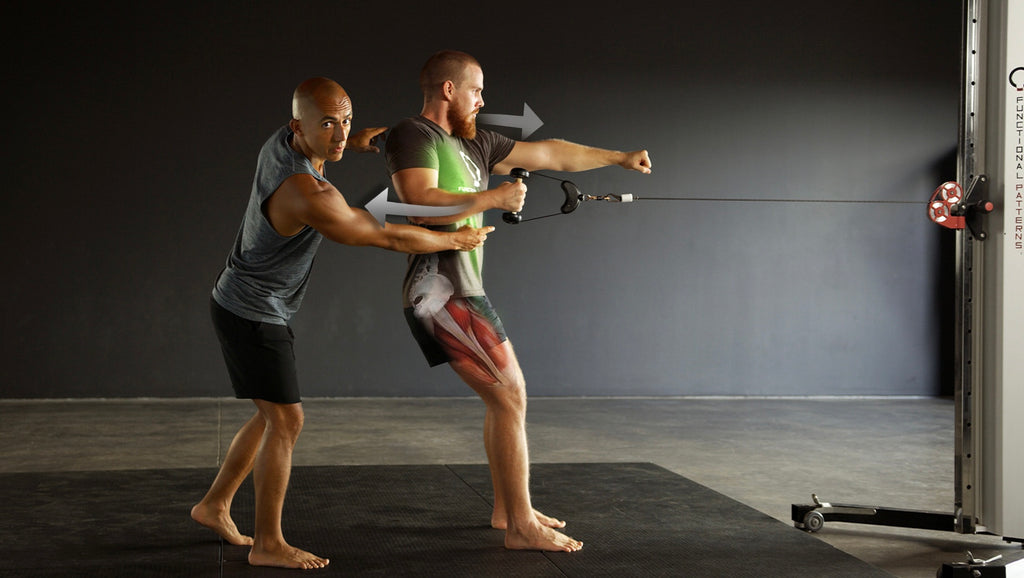
Humans are built around what we call the FP First 4: standing, walking, running, and throwing. These are the movements your body was designed to perform, and when you can perform these four functions correctly, you will be able to recruit your muscles in a way that supports your joints.

Your muscles aren’t meant to fire one at a time, the way most people train them, they are meant to work together as one connected system, so as you improve the way you stand, walk, run, and throw, you start recruiting the right muscles in the right sequence and bringing more of them into every movement. When more muscles share the work, they can produce more force without overloading any single joint, and because they’re working as a unit, they become more elastic, storing and releasing energy with each step instead of leaving your joints to absorb the impact.
That's why an adjustment can't solve the problem on its own. A restriction built through thousands of bad repetitions a day because of poor mechanics has to be undone by changing how you fundamentally move, and the only way to get to those restrictions is by teaching your muscles to create deep contractions that pull and undo them.
What to do instead
Start by looking at how you stand. Turn sideways to a mirror, relax into your normal posture, and notice where your pelvis sits in relation to your ribs. If your hips drift forward past your ribcage and your lower back arches, that's the position your joints are loading from every time you move, and it's where the work begins.
Follow these principles:
- Release the tissue that's locked down so the muscles around can fire properly.
- Realign by learning what good posture actually is and identifying the specific imbalances causing compression in your joints.
- Reload by training your muscles to engage the right way and hold that alignment under resistance, so it carries over into how you stand, walk, run, and throw.
This process is slower than a quick adjustment, but it changes the conditions that put you on the table in the first place. When your muscles are doing their job, your joints stop absorbing force they were never built to handle, and you stop needing someone to crack you back into place.
Fix the cause, not the spot that hurts
This is what we do at Functional Patterns. We teach you how to release the restrictions that keep bringing your pain back once a massage or adjustment wears off.

Our 10-Week Online Program shows you how. You'll learn how to release the adhesions that lock your body down, learn proper posture, and train with a library of exercises designed to strengthen the body the way it's meant to work. It takes 25 minutes a day, 4 days a week, and you can do it from home.
Start the 10-Week Online Program
References
- Gallup and Palmer College of Chiropractic. Gallup-Palmer College of Chiropractic Annual Report. 2018. Link
- Gallup and Palmer College of Chiropractic. Gallup-Palmer College of Chiropractic Inaugural Report: Americans' Perceptions of Chiropractic. 2015. Link
- Nahin RL, Rhee A, Stussman B. Use of complementary health approaches overall and for pain management by US adults. JAMA. 2024;331(7):613-615.
- Herman PM, Edgington SE, Hurwitz EL, Coulter ID. Predictors of visit frequency for patients using ongoing chiropractic care for chronic low back and chronic neck pain; analysis of observational data. BMC Musculoskelet Disord. 2020;21:298. doi:10.1186/s12891-020-03330-1
- Herman PM, Kommareddi M, Sorbero ME, et al. Characteristics of chiropractic patients being treated for chronic low back and chronic neck pain. J Manipulative Physiol Ther. 2018;41(6):445-455.
- Palmer College of Chiropractic Library. D.D. Palmer: The First Adjustment (Harvey Lillard's testimony, The Chiropractor, January 1897). Link
- Young KJ, Leboeuf-Yde C, Gorrell L, et al. Mechanisms of manipulation: a systematic review of the literature on immediate anatomical structural or positional changes in response to manually delivered high-velocity, low-amplitude spinal manipulation. Chiropr Man Therap. 2024;32:28. doi:10.1186/s12998-024-00549-w
- Rubinstein SM, van Middelkoop M, Assendelft WJ, de Boer MR, van Tulder MW. Spinal manipulative therapy for chronic low-back pain. Cochrane Database Syst Rev. 2011;(2):CD008112.
- Rubinstein SM, Terwee CB, Assendelft WJ, de Boer MR, van Tulder MW. Spinal manipulative therapy for acute low-back pain. Cochrane Database Syst Rev. 2012;(9):CD008880.