If you've ever told someone you're anxious, you've probably been told to breathe. Your therapist shows you box breathing, your meditation app has a whole library of breathwork, and your yoga class ends with several minutes of deep breaths. Breathwork has grown into its own industry, with certifications, retreats, and influencers rampant on social media.
The research behind it is a lot thinner than the hype. A 2023 meta-analysis of 12 randomized trials with 785 adults found that breathwork lowered stress by a small to moderate amount, and the authors cautioned that most of the trials had a moderate risk of bias.1 Nothing in it shows that breathwork resolves anxiety, and nothing in it explains why your body keeps producing anxious sensations in the first place.
Breathwork treats your breath as a skill you need to practice. For most people, the real limit is the structure that breath has to move through, and no amount of “inhale to a count of 4, exhale to 6” changes that.
Where "just breathe" came from
The idea that you can breathe your way out of panic took off in the 1980s. Psychologists in England noticed that people having panic attacks often overbreathe, and that overbreathing produces the same dizziness and tingling that people were terrified of. Their theory was that people misread those sensations as a sign of catastrophe, so they built breathing control into treatment. In a small 1986 study of nine patients, panic attacks dropped quickly once patients learned to slow their breathing.2 Breathing retraining went on to become a standard part of panic treatment.
Then the research caught up. Critics pointed out early on that hyperventilation was neither necessary nor sufficient to cause panic.3 When a 2018 analysis of 72 trials broke panic treatment down into its parts, breathing retraining had only a small effect on whether people got better. What helped was deliberately facing the body sensations they feared.4 Going towards what they resisted rather than trying to push it away.
By then, breathwork had already gone mainstream. A retired Navy SEAL commander named Mark Divine gave the four-count "box breath" its name and taught it to thousands of people,5 and Wim Hof turned rapid breathing and ice baths into a global brand. The clinical world was moving away from breathing retraining while the wellness world was building an industry on it.
Your diaphragm has two jobs
Before breathing is a mental skill, it's a mechanical one.
Your diaphragm is a dome-shaped muscle that sits under your ribs. When you inhale, it pulls down, the pressure in your chest drops, and air rushes in. For that to work, the diaphragm has to start out in its dome shape, your ribs need room to expand, and your trunk needs enough tension to give the diaphragm something to push against.

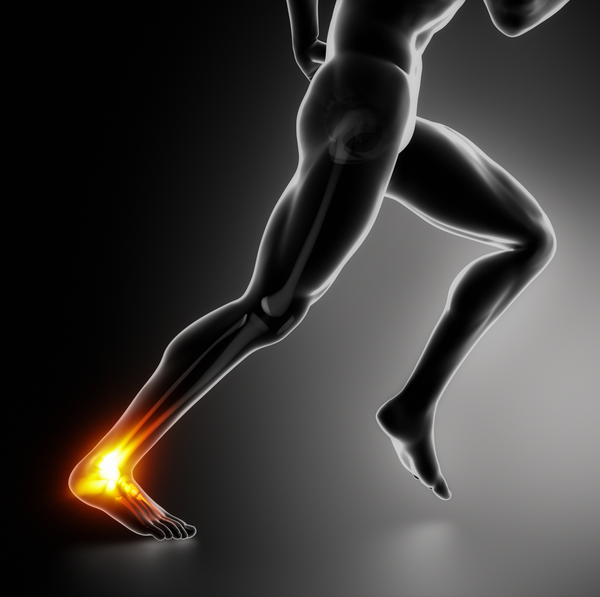
The diaphragm sits right under your lungs (image: Scientific Animations, CC BY-SA 4.0)
Its second job is holding you upright. Researcher Paul Hodges found that the diaphragm contracts to stabilize your trunk every time your arms or legs move, and when he made people breathe harder, that postural work dropped off.6 The two jobs compete for the same muscle. If your trunk can't hold itself up, the diaphragm picks up the slack and breathing gets whatever is left over.
How posture steals your breath
Look around any office and you'll see the same posture: ribs flared forward, upper back rounded, head pushed out in front of the shoulders, lower back arched to make up for it. Hours of sitting lock it in.

Flared ribs flatten the diaphragm, so it has less room to move and less leverage. Your body still needs air, so your neck and upper chest take over and start hauling your rib cage up with every breath. That pattern is meant for a sprint. For a lot of people, it's how they breathe all day.
A rounded upper back makes it worse. When researchers put 94 young adults in a suit that held them in a severely hunched posture, the amount of air they could move dropped by about a quarter.7 Over decades, it adds up. In the Framingham study, which followed people for 16 years, women with the most severe upper back rounding lost lung function at a rate the researchers compared to smoking up to 15 cigarettes a day.8
Now hand that person a routine that says "breathe deep into your belly." Their structure can't handle that cue, so they pull harder into areas of restriction and poor mechanics. The shoulders rise, the ribs flare even more, and the deep breath just turns into a harder one. And with this the body senses a threat, undistributed tension and signals anxiety.
Why more air isn't calming
Some of the most popular styles of breathwork are basically controlled hyperventilation. The Wim Hof Method is the best studied. In a 2014 study, people trained in the method saw their adrenaline shoot up during the breathing, and the researchers described it as voluntarily switching on the fight-or-flight system.9 A later study found the breathing alone was enough to raise adrenaline.10
That's an interesting finding in a lab. It's not what you want when your nervous system already struggles to settle down.
Breathe faster or deeper than your body needs and you blow off too much carbon dioxide. The blood vessels in your brain tighten, and you feel lightheaded, dizzy, and tingly in your hands and around your mouth.11,12 Those are the exact sensations anxious people are most afraid of.
When you start watching every breath
Breathing runs on autopilot. It kept going all night while you slept, and it's going right now without any help from you.

Anxiety pulls your attention inward. A 2021 brain imaging study found that anxiety had less to do with how well people could sense their breathing and more to do with what they believed about it.13 The anxious brain isn't short on information about the body. It's paying too much attention to it.
And here again lies the importance of your structure. Breathe into a poorly aligned structure with a deflated posture and the sensations are anything but calming.
Most breathwork asks for even more attention. Count the inhale, hold, count the exhale, check in. Do that every day and you teach yourself that breathing is something you have to manage, and that something might go wrong if you stop. Psychologists call this a safety behavior. The ritual gets the credit for getting you through, so your brain decides the feeling must have been dangerous. That's also why adding diaphragmatic breathing to exposure therapy for anxiety didn't improve results.14
Built to stand, walk, run, and throw
Almost all breathwork happens sitting or lying down. Real life doesn't.
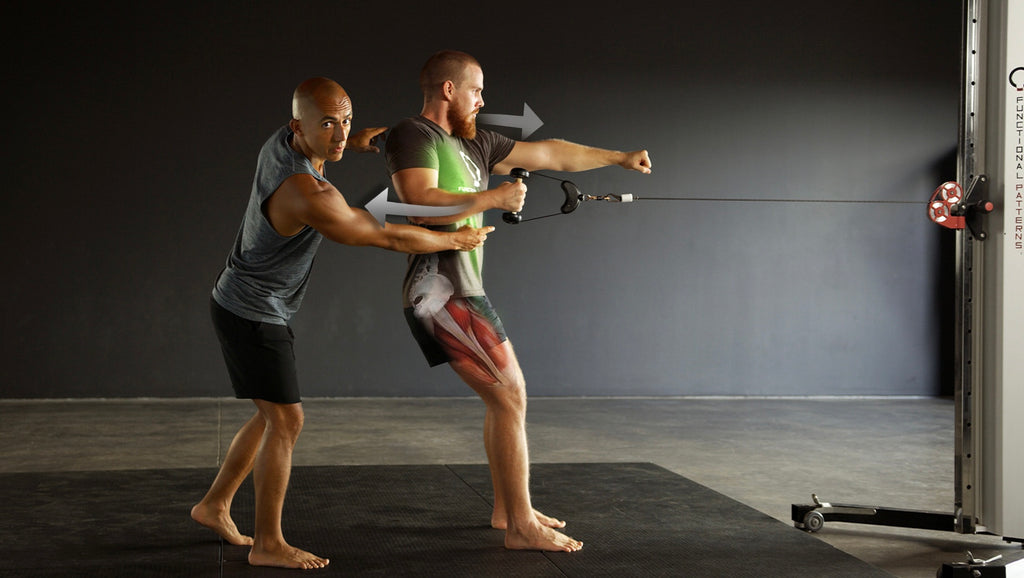
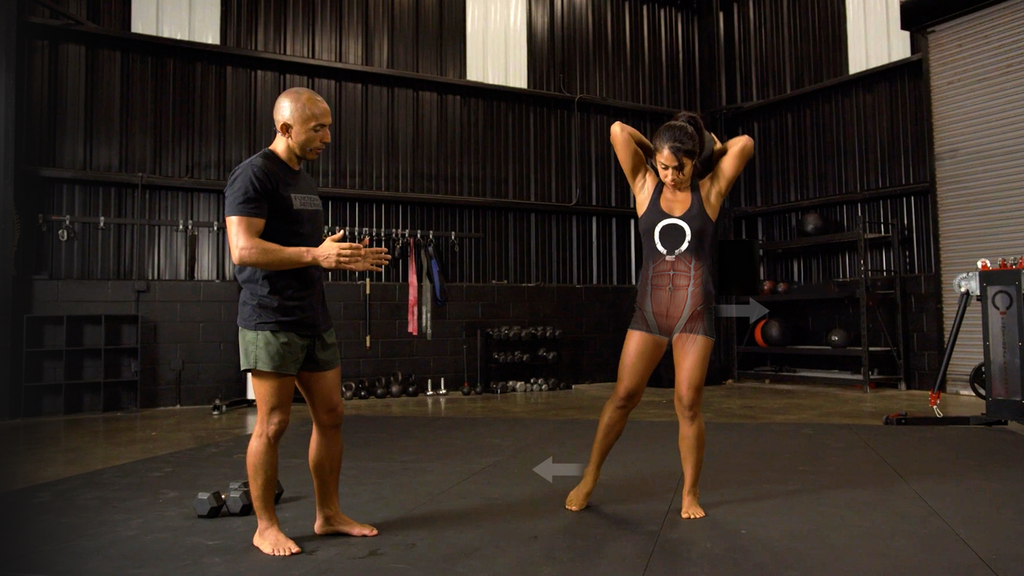
Humans are built around what we call the FP First 4: standing, walking, running, and throwing. When you can do these four well, your ribs rotate with each step, your trunk turns against your pelvis, and your breathing falls into that rhythm without anyone counting. The harder you move, the deeper you breathe, and none of it takes conscious effort.
Ten calm minutes on a mat can't train that. Most people get up from a breathwork session with the same flared ribs and the same neck breathing they lay down with, and that's the pattern they breathe with for the rest of the day.
What our clients say
Michelle had anxiety her whole life and dealt with panic attacks. Every time she was stressed, someone told her to breathe or meditate. It never worked, and she didn't understand why until she started FP. Her rib cage was so compressed that she couldn't take a full breath in the first place. As she put it, "If I can never take a deep breath, that's going to be anxiety producing." Her ribs opened up during the core and thoracic spine weeks of the 10-Week Program, and at the time of her interview she hadn't had a single panic attack since starting.


Michelle's progress with FP
Nyssa, a client turned FP practitioner, had always been a shallow breather. She was scared of big, deep breaths and had quit running because of it. About two months into training twice a week with an FP practitioner, she could breathe properly for what felt like the first time. She tied it to how compressed her rib cage had been, and her mental health improved along with it.
Another FP client spent years in orthodontics that never fixed their jaw or their mouth breathing. Once decompression work on the spine let the jaw sit further forward, they breathed through their nose for the first time in their life, and their sleep improved.


Results from FP client
None of them set out to fix their breathing. They fixed their structure, and the breathing came with it.
What to do instead
Start by looking at how you breathe. Stand sideways to a mirror, relax into your normal posture, and breathe the way you usually do. If your shoulders and upper chest do most of the lifting, or your lower ribs flare forward with every inhale, your diaphragm isn't doing its job. Then look at where your ribs sit over your pelvis. If your ribs are flared up and your lower back is arched, that's the position your breathing is working from all day.
Follow these principles:
- Release the tissue that's locked down around your ribs, upper back, and hips so your rib cage has room to move.
- Realign by learning what good posture actually is, with your ribs stacked over your pelvis so your diaphragm gets its dome back.
- Reload by training your muscles to hold that position under resistance, so it carries over into how you stand, walk, run, and throw.
All of the things Functional Patterns will teach you.
This takes longer than a five-minute breathing exercise, but it changes the reason your breathing is off in the first place. As your structure improves, your breathing gets lower, quieter, and slower on its own.
Fix the structure, not the breath
Breathwork isn't a scam. Slow breathing can take the edge off a hard moment. The problem is that it's sold as an anxiety cure and a nervous system reset, when what most people need is a body that doesn't need its breathing managed at all.
That's what we do at Functional Patterns. Our 10-Week Online Program shows you how. You'll learn to release the tension locking your rib cage down, learn proper posture, and train with a library of exercises built around how the body is meant to move. It takes 25 minutes a day, 4 days a week, and you can do it from home.
Start the 10-Week Online Program
References
- Fincham GW, Strauss C, Montero-Marin J, Cavanagh K. Effect of breathwork on stress and mental health: a meta-analysis of randomised-controlled trials. Sci Rep. 2023;13:432.
- Salkovskis PM, Jones DRO, Clark DM. Respiratory control in the treatment of panic attacks: replication and extension with concurrent measurement of behaviour and pCO2. Br J Psychiatry. 1986;148(5):526-532.
- Bass C. Panic attacks and hyperventilation (letter). Br J Psychiatry. 1987;150(4).
- Pompoli A, Furukawa TA, Efthimiou O, et al. Dismantling cognitive-behaviour therapy for panic disorder: a systematic review and component network meta-analysis. Psychol Med. 2018;48(12):1945-1953.
- Police Magazine. Box Breathing.
- Hodges PW, Heijnen I, Gandevia SC. Postural activity of the diaphragm is reduced in humans when respiratory demand increases. J Physiol. 2001.
- Uchida M, Yamaguchi K, Tamai T, Kobayashi K, Tohara H. Effects of simulated kyphosis posture on swallowing and respiratory functions. J Phys Ther Sci. 2023;35(8):593-597.
- Lorbergs AL, et al. Severity of kyphosis and decline in lung function: the Framingham Study. J Gerontol A Biol Sci Med Sci. 2017;72(5):689-694.
- Kox M, et al. Voluntary activation of the sympathetic nervous system and attenuation of the innate immune response in humans. PNAS. 2014.
- Zwaag J, et al. The effects of cold exposure training and a breathing exercise on the inflammatory response in humans: a pilot study. Psychosom Med. 2022;84(4):457-467.
- Laffey JG, Kavanagh BP. Hypocapnia. N Engl J Med. 2002;347(1):43-53.
- Lewis JL III. Respiratory Alkalosis. Merck Manual Professional Version. 2025.
- Harrison OK, et al. Interoception of breathing and its relationship with anxiety. Neuron. 2021.
- Deacon B, et al. Do cognitive reappraisal and diaphragmatic breathing augment interoceptive exposure for anxiety sensitivity? J Cogn Psychother. 2012.