If cardio is the best part of your day, you're not alone. Millions of people lace up every morning for a 3-mile run, a 45-minute spin class, or an hour on the elliptical, and most of them will tell you they feel incredible afterward. That feeling has a name, the runner’s high, which is the wave of euphoria, calm and reduced pain that tends to set in after a sustained stretch of moderate to hard effort, and it’s a big part of why people keep coming back
That high comes in large part from endorphins, chemicals your brain releases when you put your body under sustained physical stress. What most people don't consider is that the rush itself can be the problem, because endorphins are your body's way of dulling pain.
How Jogging Became Health Advice
For most of history, nobody ran unless they had somewhere to be. That changed in the 1960s, when Oregon track coach Bill Bowerman came back from a trip to New Zealand, where he'd seen everyday people jogging together, and published a booklet in 1966 called Jogging that sold over a million copies. Two years later, Air Force physician Kenneth Cooper published Aerobics, which gave the idea a scientific-sounding name and a point system for tracking how much you did. By the 1970s, running was a national craze, and by the 1980s, gyms were lining their floors with treadmills, bikes and steppers.

The message that stuck was simple: more cardio means a healthier heart. What nobody asked was what happens to the rest of the body when you repeat the same motion thousands of times a week on a structure that isn’t primed to support it.
What the high is actually doing
Endorphins are natural opioids your body releases under physical stress. When you push through a long run, your brain floods your system with them so you can keep going despite the strain, which is useful if you're running from a predator and much less useful if you're using that same mechanism every day to push through a body that's already hurting.

Pain is feedback, and when you feel pain it's your body telling you that how you're moving needs to change, and when you dull that signal every day, you lose the information you need to fix the problem.
Most people are dealing with compression all throughout their body, and instead of fixing it, they learn to move around it. Moving around that compression is what ends up causing pain, and while the endorphin rush from cardio can mask that pain for a while, it never resolves it. You walk out of the gym feeling great while the problem underneath keeps getting worse, and eventually it catches up with you to the point where you can't move without pain at all.
Your joints take the hit
That compression exists in your body because your muscles don't know how to support your joints when you move. When your structure is organized, tension is spread evenly across the muscles and connective tissue built to handle it, but when you're not, the force leaks and the load goes straight into your joints.

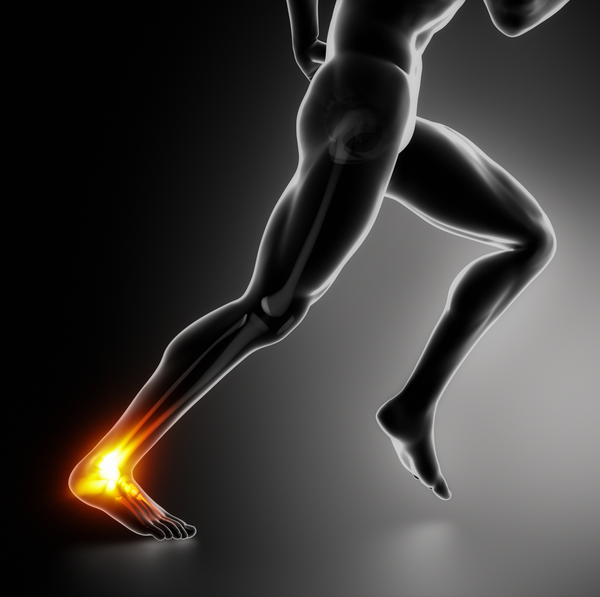
Now multiply that by the thousands of strides in a single run, several times a week, for years. Every repetition lands on the same cartilage and the same supportive tissue, and since the endorphins are doing their job, you never feel it as it happens. The damage builds quietly until the cartilage and supportive tissue start to wear down, and that's how people get injured without ever seeing it coming.
It's no surprise that a widely cited review of running injuries found that anywhere from about 19% to 79% of runners suffer a lower extremity injury in a given year.1 Those numbers aren't coming from people who stopped moving, they're coming from people who moved a lot without ever learning how to move well.
Stuck in fight-or-flight
On top of the joint grinding, steady state cardio keeps your body under constant stress. Long, repetitive bouts of hard cardio push you into a catabolic, sympathetic state, which means your body is breaking down because it's stuck in fight-or-flight.
The research backs this up: when researchers analyzed hair samples from 304 amateur endurance athletes (long-distance runners, triathletes and cyclists) and compared them to 70 controls, the athletes had higher cortisol levels across months of samples, and the more they trained, the higher their cortisol went.2 A separate study found that vigorous physical activity was linked to elevated long-term cortisol, while moderate activity showed no link at all.3
Staying in that state can wreck your sleep and keep you from recovering from the very workouts you're putting in, so you end up training harder to feel the same rush while your body falls further behind on repair.
We weren't built for this
Think about how humans actually moved for most of our history. We walked a lot, and we sprinted or threw when we had to, but our tissues spent much of their time at rest. Nobody was jogging at the same pace for an hour, five days a week, because there was no reason to.

That's why the FP First 4 are standing, walking, running and throwing. These are the functions your body was designed around, and when you perform them efficiently, your muscles share the load the way they're supposed to. Most people aren’t efficient in these four functions and put themselves through hard workouts reinforcing poor mechanics.
Cardio costs you power
The second cost of cardio is one you won’t notice until it’s already gone, and that’s your ability to be explosive.

Look at people in their sixties and older. You rarely see them jumping, sprinting or reacting quickly, and for most of them the ability to move explosively is gone entirely. As people age, endurance isn't the first thing to go, because what they lose first is something far more important, and that's power. One study on aging found that muscle power declined at roughly twice the rate of strength, whether people were trained or not.4 Power is what lets you catch yourself when you trip, get up off the floor, or climb stairs without thinking about it.
The more cardio you do, the more compressed your body gets, and repeating the same patterns over and over without ever learning to move more efficiently slowly drains that power over time. You end up with a body that can go for an hour at one speed but can't produce force when it actually matters.
Less is more
None of this means you should stop moving. It means the volume of cardio you're doing, on a body that can't support its own joints, is costing you more than it's giving you.
That's why we often start people with our Movement Elimination Protocol. By cutting out the compensatory training for a period of time, you take away the constant flood of endorphins and stimulation, and you finally get to feel what's actually going on in your body. Sometimes the pain gets quieter, and sometimes it gets louder now that nothing is masking it, but either way you have a real baseline to work from.
From there, learning how to stand, walk, and run with good mechanics, and training your body to decompress under load will build the conditioning you're after without grinding your joints down or keeping you stuck in fight-or-flight. When your structure improves, your cardio improves with it, because a body that moves efficiently doesn't waste energy fighting itself on every step.
Train your conditioning the right way
That's what we do at Functional Patterns. We teach you how to train without the compression so you can improve both your cardio and your strength without pain.
If you want conditioning that doesn’t cost you your joints, our 10-Week Online Program is where to start. You’ll learn how to release the adhesions that keep your body compressed every time you run, learn the posture that lets your muscles support your joints instead of leaving them to absorb the impact, and train with a library of exercises designed to build your strength and conditioning the way your body is meant to work, all in 25 minutes a day, 4 days a week, from home.
Start the 10-Week Online Program
References
- van Gent RN, et al. Incidence and determinants of lower extremity running injuries in long distance runners: a systematic review. Br J Sports Med. 2007;41(8):469-480.
- Skoluda N, et al. Elevated hair cortisol concentrations in endurance athletes. Psychoneuroendocrinology. 2012;37(5):611-617.
- Gerber M, et al. Objectively assessed physical activity is associated with increased hair cortisol content in young adults. Stress. 2013;16(6):593-599.
- Pearson SJ, et al. Muscle function in elite master weightlifters. Med Sci Sports Exerc. 2002;34(7):1199-1206.